Case · Luxembourg · 2020 to 2022
Luxembourg in Transition: Soil & People
A national consultation asked what a transition compatible with 1.5°C would mean for Luxembourg and the region it depends on. Our team answered through land, through what it is used for, whom it feeds and what each choice does to its carbon.
- Client
- Ministry of Energy and Spatial Planning, Luxembourg
- Period
- October 2020 to January 2022, in three stages
- Team
- 2001, 51N4E and LOLA, with scientific, environmental and mobility specialists
- My part
- Led 51N4E's contribution and held the ministry relationship. Wrote the introductions and the chapters on land take, diet shift and transferable development rights. Designed and documented the engagement.
- Stage
- Completed. The development rights instrument was adopted as a flagship project and named among the PDAT's next steps in July 2023.
Land as the measure
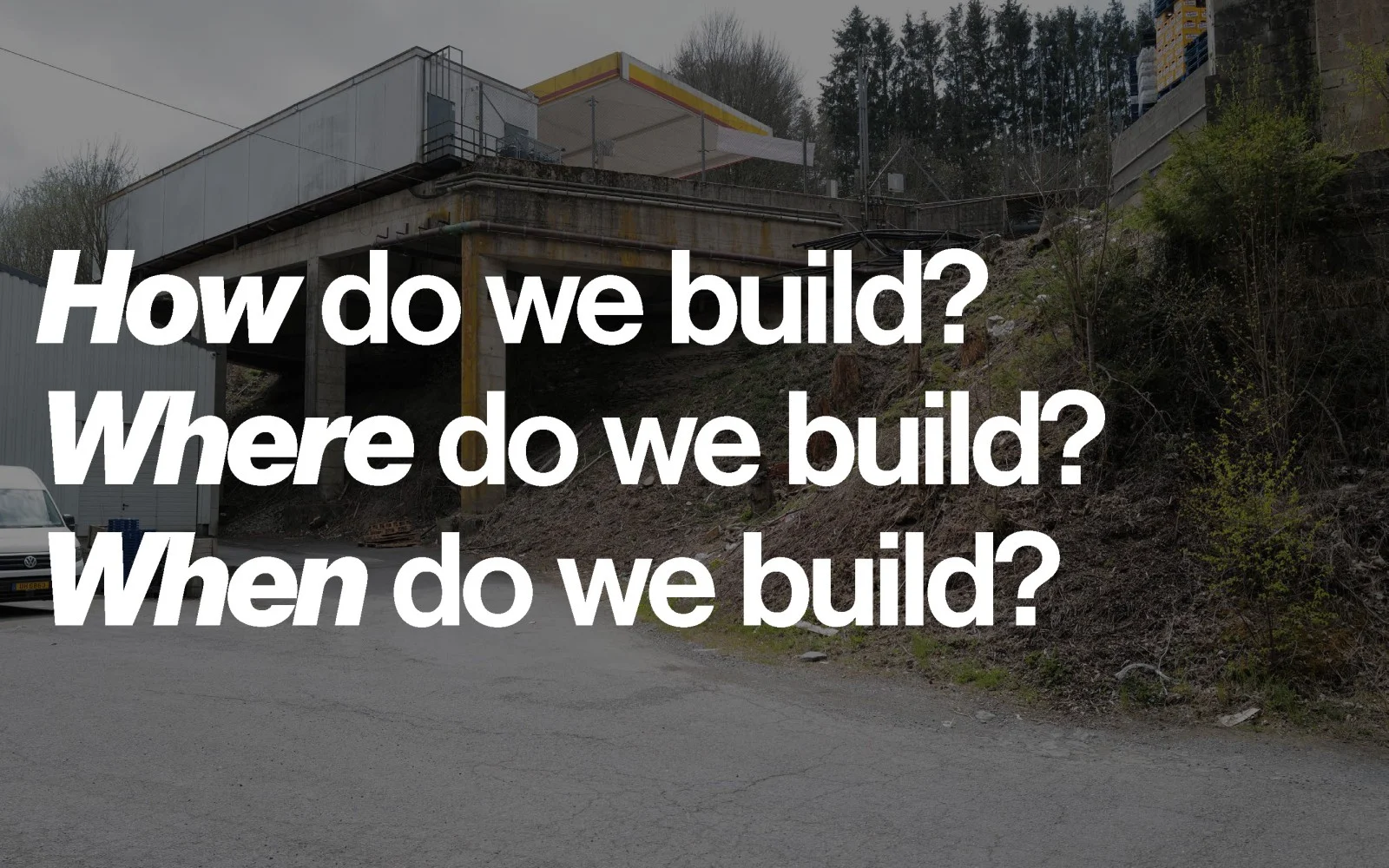
The consultation asked for more than technical substitution. Population growth, development permits already issued, diets, intensive farming, forestry and urban land take each had carbon and land consequences, and those consequences crossed the borders of municipalities and of the country itself.
We adapted a European 1.5°C pathway to Luxembourg's functional region, using emissions per person to translate it, and compared business as usual with transition scenarios for land use, food and forestry. The region was read as a bio-functional territory, defined by the resources it depends on as well as by its labour market and its borders. The adaptable land-management tool we developed with our partners lets a municipality test those scenarios against its own conditions, and 51N4E later reused it across its territorial work.
What a diet does to a landscape
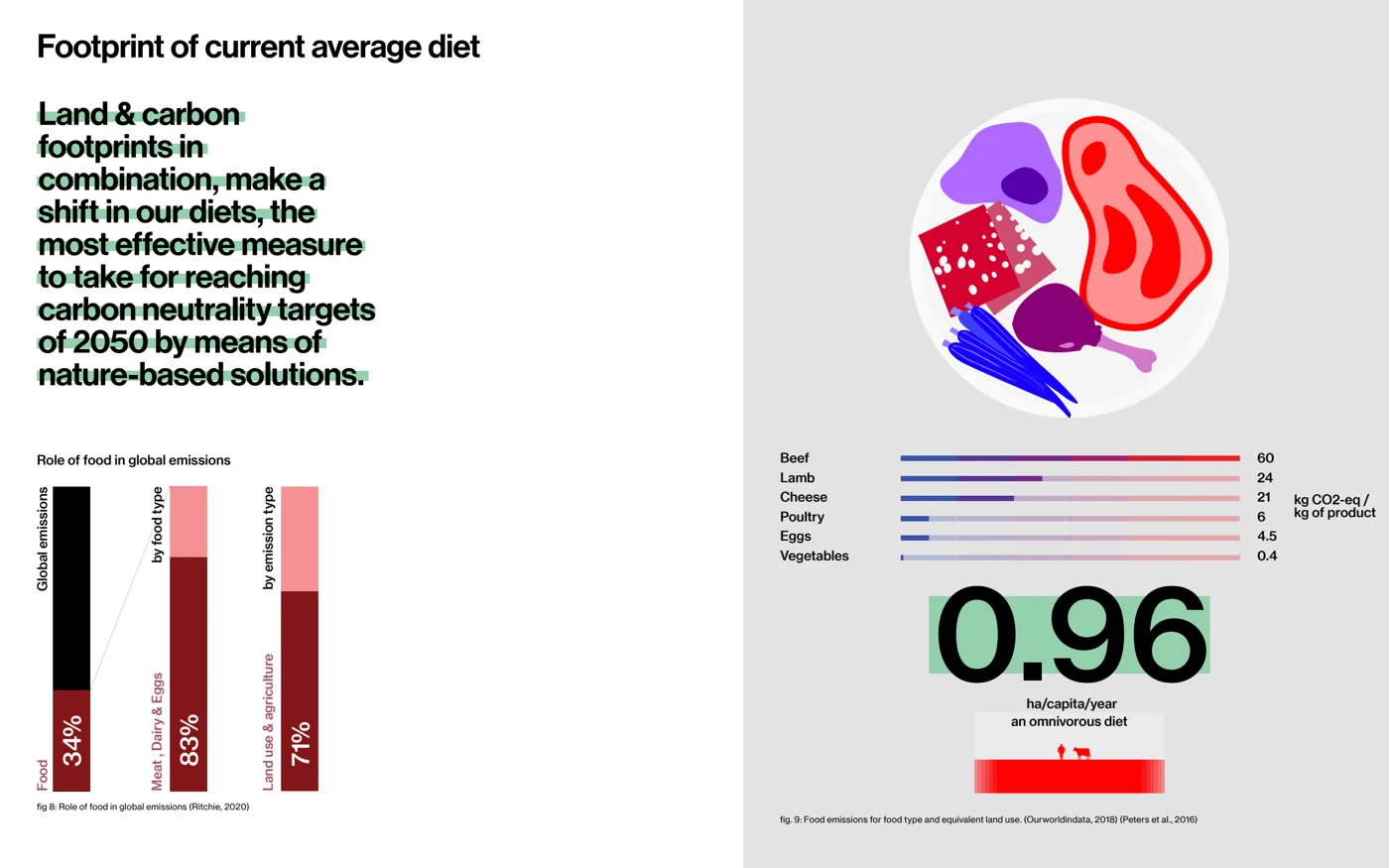
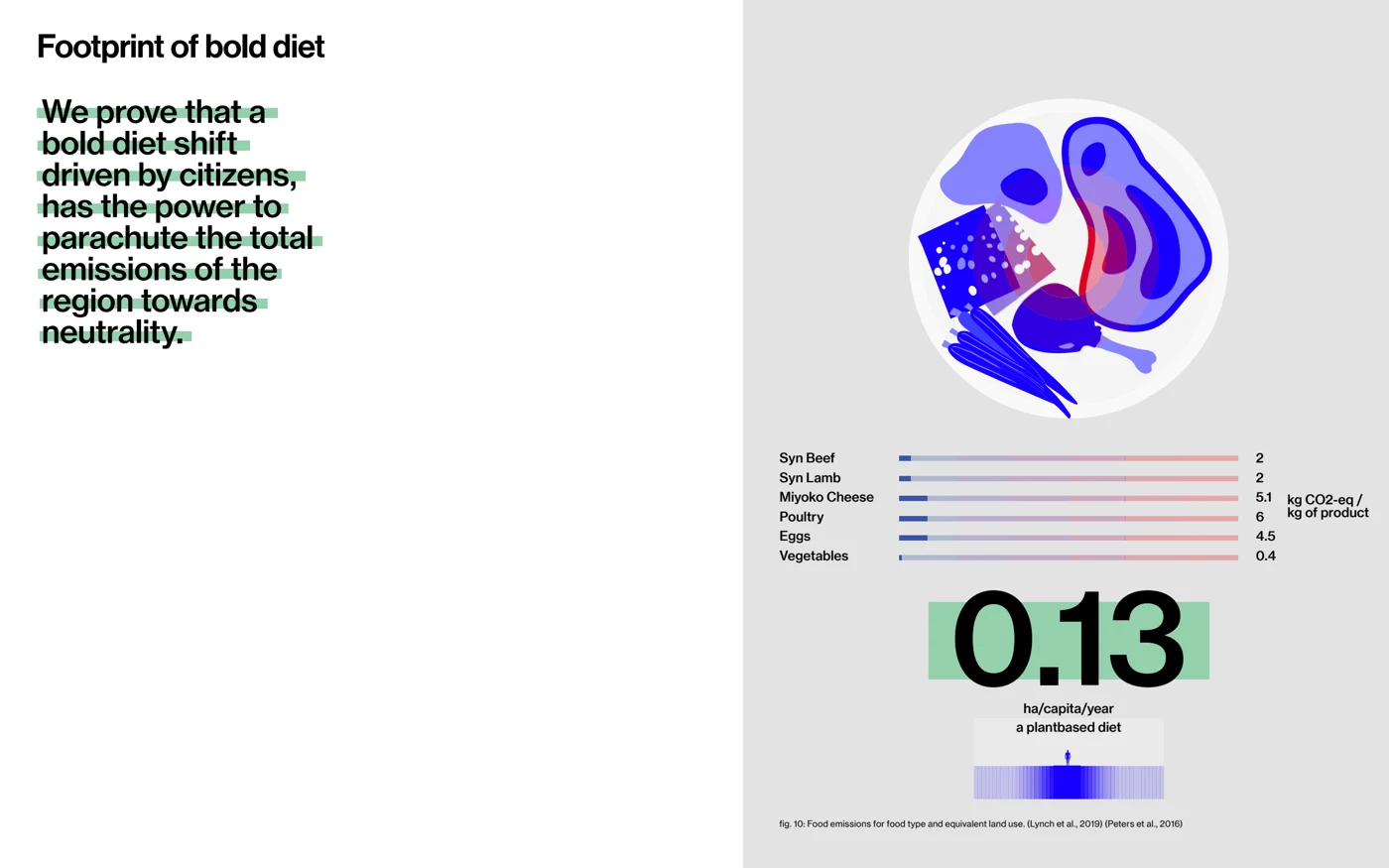
Diet became the basis of the whole study. In the land-management tool the diet scenarios moved the results as much as the population forecasts did, and the 2050 land-use scenarios for forests and farmland were built on them. The Bold scenario models a footprint equivalent to a plant-based diet one day a week in 2025, three and a half days in 2035 and six days in 2050, and estimates the pasture and cropland this could free.
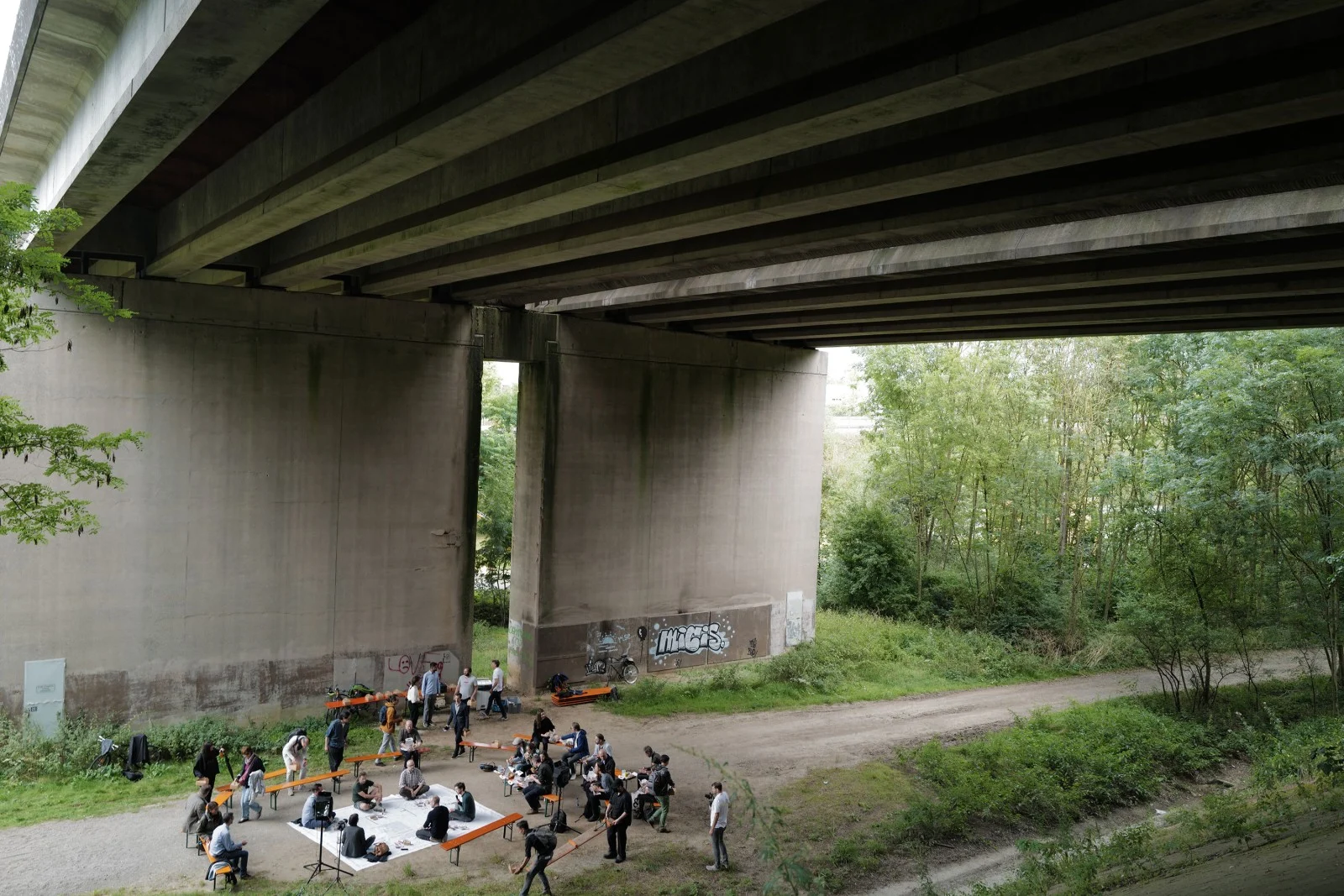
These are model outputs, and we tested their feasibility with the people who would carry them. Two roundtables on agriculture in transition brought in dairy and pig farmers, a winegrower, foresters, the livestock association, Meng Landwirtschaft, the wood cluster and the agricultural school, and a citizens' committee examined food footprints. In September 2021 I organised a lunchtime conversation beside arable land due for rezoning, where a nutritionist, an organic grower, a communications specialist and a vegan-nutrition adviser discussed what such a shift would take.
Rights already granted
Members of the scientific committee argued for degrowth as the answer to land take. I shared their aim, and held that a transition the country could implement had to deal with the development rights already granted on farmland, often held by owners with no need to build.
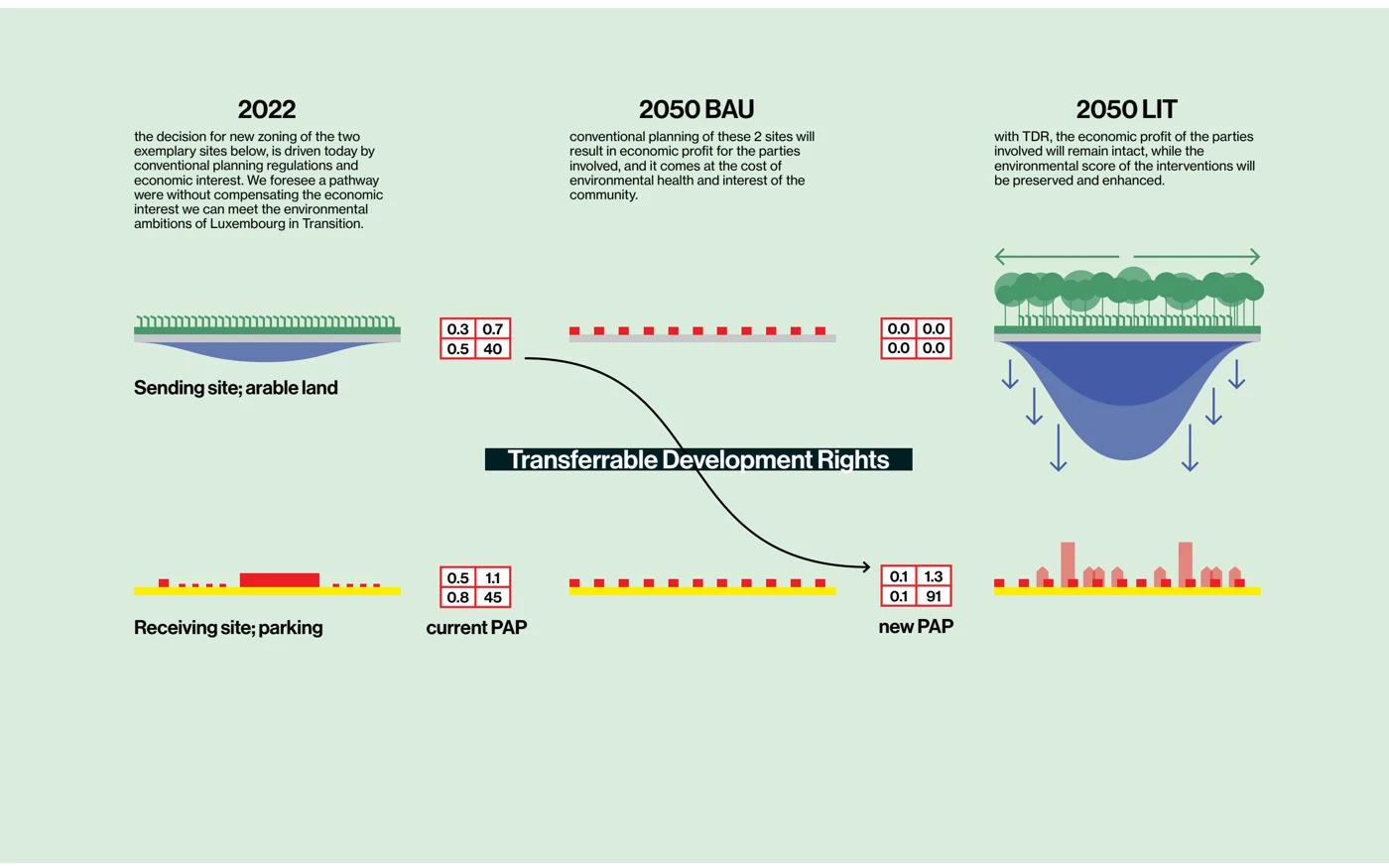
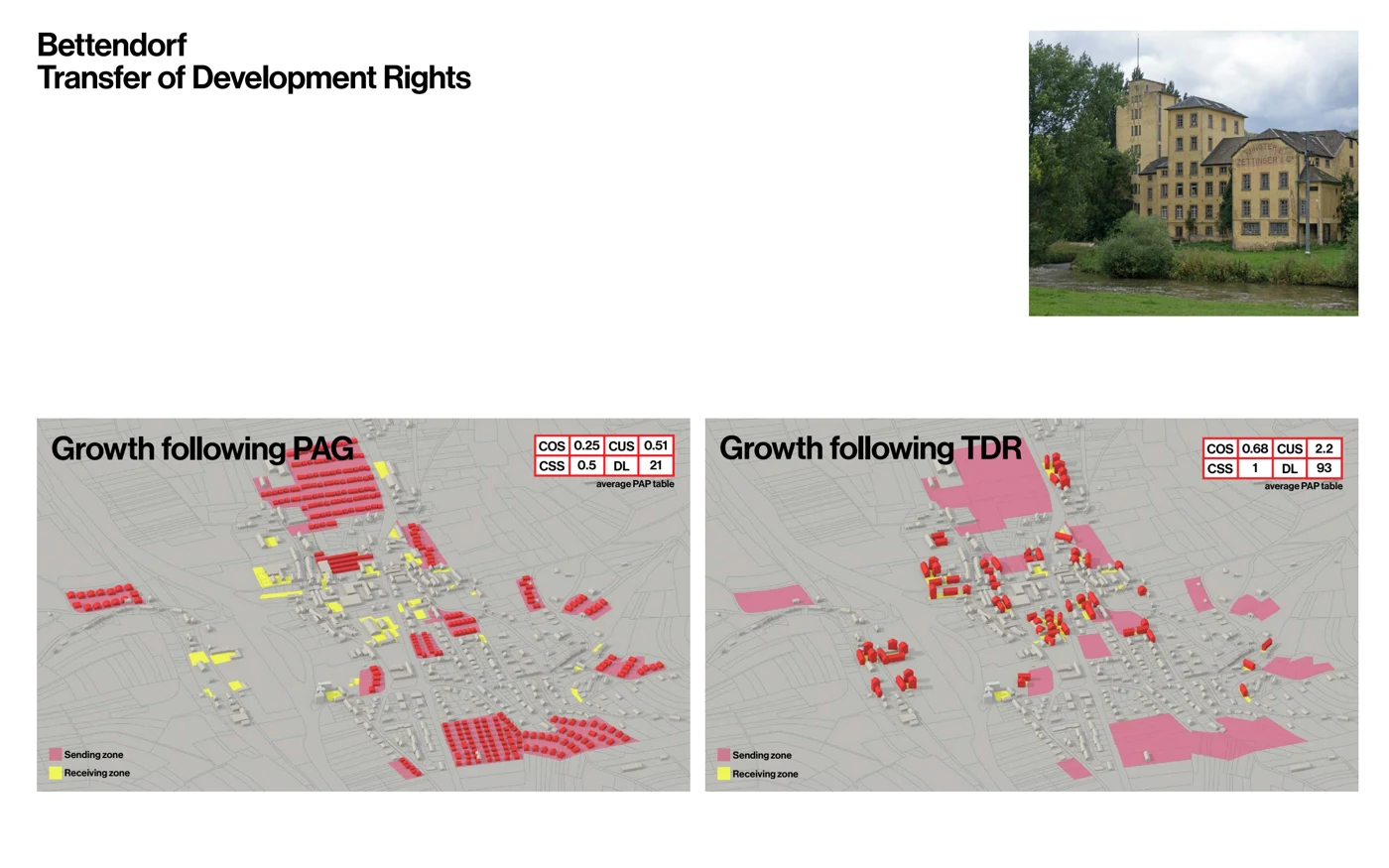
Transferable development rights are an established idea. The design I drew up for Luxembourg separates the right to build from the land itself, so that owners of protected land can sell its development potential without selling the land. Developers can then gather those rights where infrastructure and public transport already exist, across municipal boundaries where needed. Minister Claude Turmes adopted the instrument as a flagship project of Luxembourg in Transition. In July 2023 it was named among the next steps of the PDAT, the national spatial planning programme, and a working group was set up to implement it.
Two places to test it
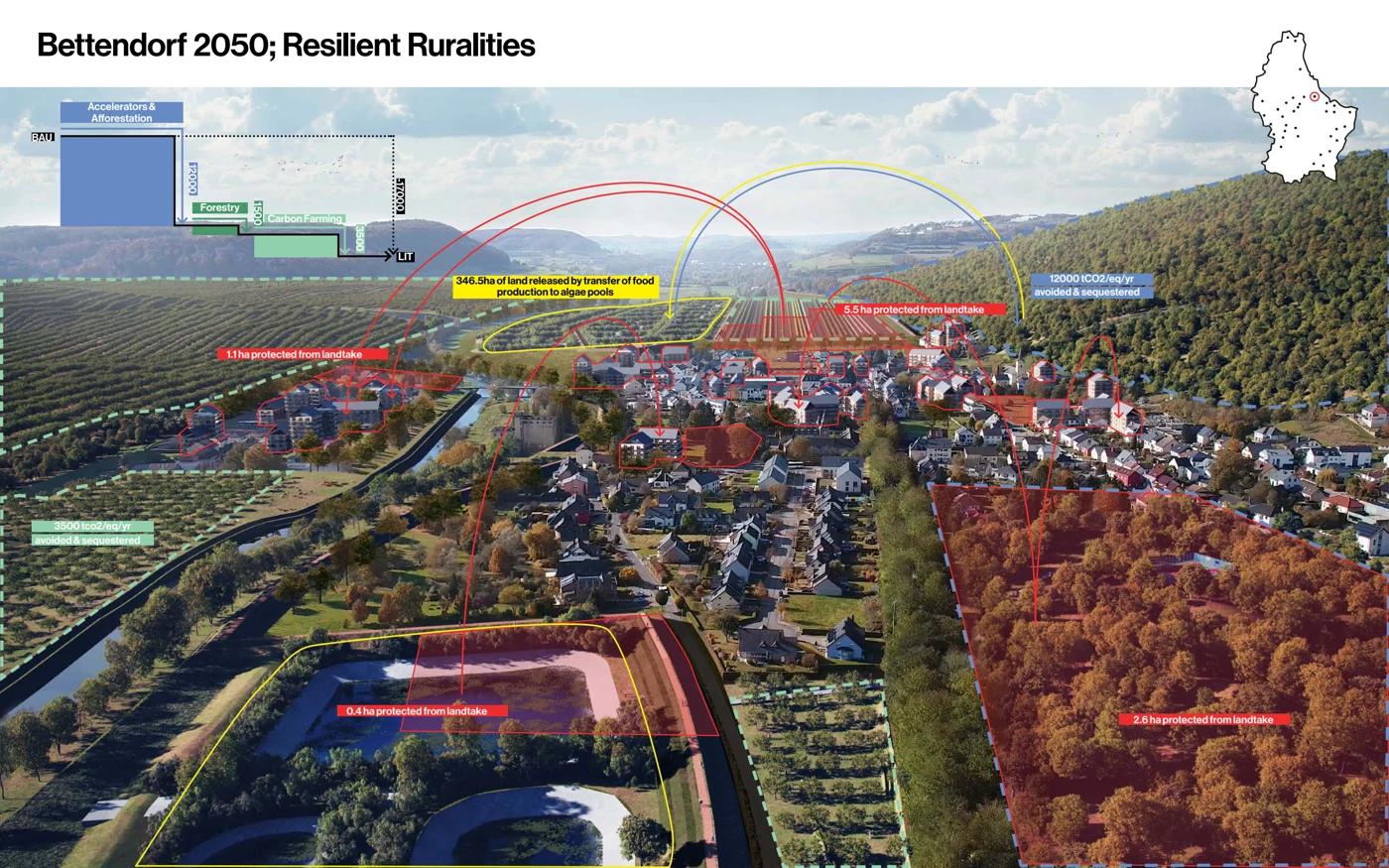
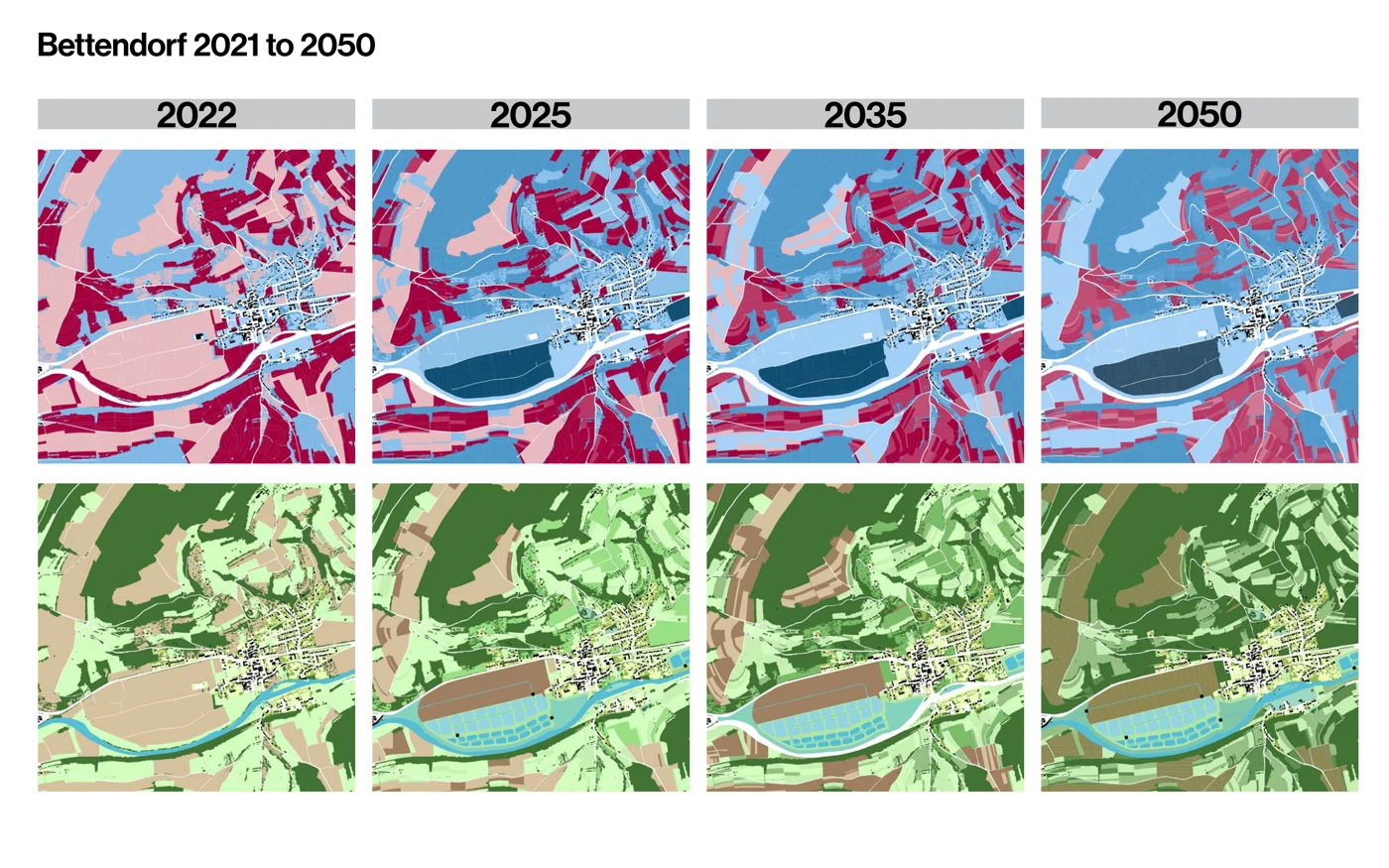
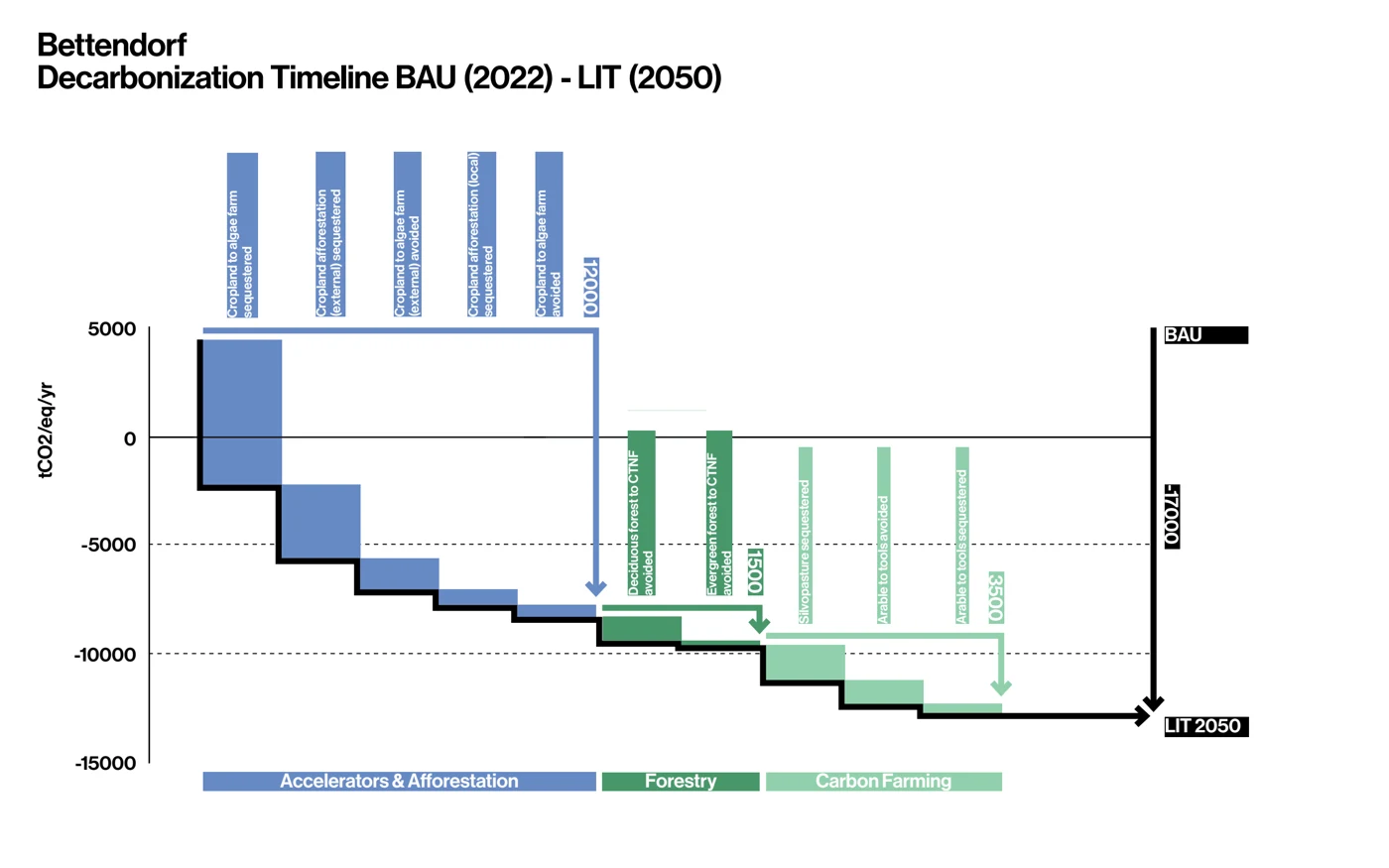
Local visions for suburban Helfent and rural Bettendorf tested the regional reasoning at the scale of a village. Existing and proposed land-use plans, compact development, new arrangements for development rights, and changes in farming and forestry were set against business as usual, year by year to 2050. They showed how density could support local services and new rural economies while ecological functions were kept or restored. The carbon and land values they carry are simulated responses to the scenario assumptions.
What followed
The consultation informed the guiding approach of the PDAT, adopted in 2023, and travelled as an exhibition in 2022, the year the project was also shown at IABR in Rotterdam. It led to the Greenbelt and Interurban Landscapes commissions, and at 51N4E it became the seed of Territories in Transition.
Several directions in the study's food timeline, from a plant-based day each week to public procurement of local produce, have since appeared in Luxembourg's food policy. Among them are a vegetarian-day pilot in school canteens, a procurement platform for local produce and, in 2026, the first national food action plan. Only the PDAT credits the consultation directly.
Credits
Luxembourg in Transition, Soil & People. Consortium of 2001, 51N4E and LOLA, with scientific, environmental and mobility specialists, for the Ministry of Energy and Spatial Planning. Reports in December 2020, May 2021 and December 2021. Images by 51N4E, LOLA and 2001. Figures are model outputs of the consortium.